Divinity Atlas
A cross-referenced encyclopedia of religions, deities and esoteric systems, written to a stated method. This page states the method, and then states where the atlas fails to meet it.
A Shelf at Home
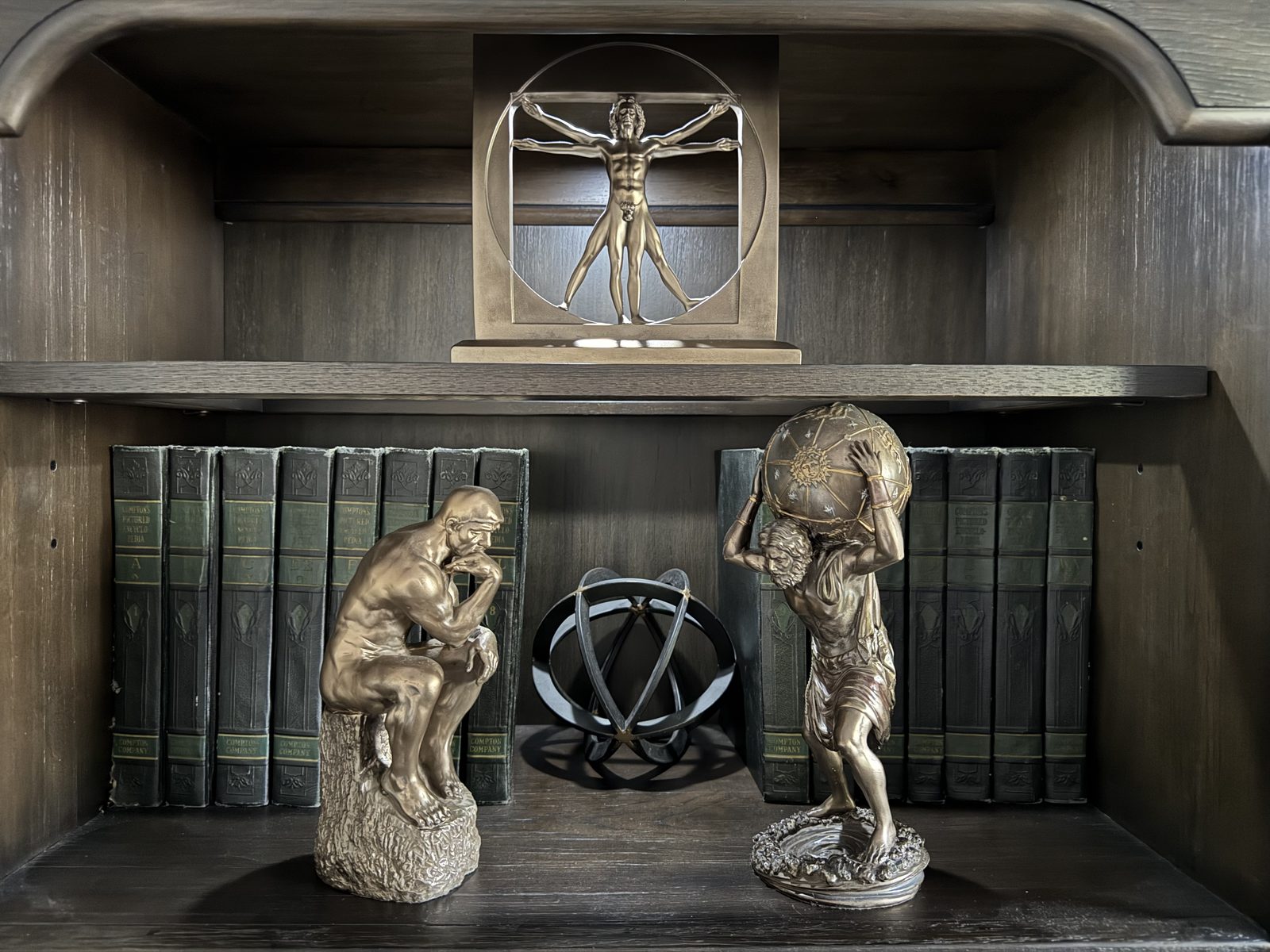 A bronze Vitruvian Man stands on the upper shelf. Below it, Rodin's Thinker, an armillary sphere and a bronze Atlas carrying the celestial globe sit between volumes of Compton's Pictured Encyclopedia.
What This Is
A directory of what traditions hold, with the links between them made explicit.
The atlas holds entries for religions, denominations, deities, scriptures, beliefs, practices, festivals, disciplines and orders, alongside the correspondence systems those traditions built: astrology western, Vedic and Chinese, the tarot, kabbalah, alchemy, numerology, the runes and ogham, the I Ching, the chakras, sacred geometry, the calendars. Every entry is linked to everything it touches, in both directions, so a planet reaches its metal, its deity, its fixed stars and its tarot trump, and each of those reaches back.
Those 31,330 articles sit on 16,275 entries across 242 kinds of thing, which is worth saying aloud: most of the atlas is a description and a web of links, and only part of it has an essay attached. Where the essays are, they are long, and the deepest entry carries six of them. Zoroastrianism and the Golden Spiral are among the fullest. Reading is free and always has been - nothing on the browsing side of this site is behind a payment or an account.
Contested Claims Are Named, Not Settled
Where specialists disagree, the entry says so and stops.
An encyclopedia of this subject is under constant pressure to settle arguments it has no standing to settle. The rule here is that a live scholarly disagreement is reported as a disagreement, with the positions attributed, and the entry does not pick a winner it cannot back.
The article on Zoroastrianism and its supposed influence on Abrahamic eschatology sets out both cases - that the Achaemenid contact is real and the resemblance is real, and that the Pahlavi texts stating the scheme most fully were written down centuries after the Jewish material they are said to have shaped - and then declines:
Both positions are held by serious specialists in the field, and the disagreement will not be settled by argument alone. It would take datable Iranian evidence from the relevant centuries, which does not at present exist. The honest statement is that the resemblance is real, the contact is real, and the dependence is unproven in either direction.
From Zoroastrianism, third article
The reverse also holds. Where a widely repeated claim is simply false, the entry says so and shows the arithmetic. The Wicca entry traces the figure of nine million witches killed to Gottfried Christian Voigt, who in 1784 took thirty burnings recorded at Quedlinburg over fourteen years and extrapolated that rate across the whole of Europe for eleven centuries, and to the suffragist Matilda Joslyn Gage, who rounded his total to nine million in 1893. Against that it sets the figure from surviving trial records: something like forty to sixty thousand executions across Europe between roughly 1450 and 1750, with men perhaps a fifth to a quarter of the dead.
The Golden Spiral carries a whole section titled The claims that do not hold, which disposes of the nautilus shell (measured ratios near 1.31 to 1.33, against phi at 1.618), the Parthenon, the Great Pyramid, and the chain of quarter-circle arcs through Fibonacci squares that almost every published illustration mislabels as a golden spiral. The same entry is emphatic about what is true - phyllotaxis, the golden angle at 137.5 degrees, and the 1992 experiment by Douady and Couder showing that the angle falls out of local repulsion by itself. Debunking and enthusiasm are not opposites here.
Modern Systems Are Dated
A twentieth-century system does not get to borrow ancient authority.
Much of what circulates as ancient wisdom was assembled recently, often by one identifiable person, and is none the worse for it - but the date belongs in the entry. Human Design was originated by Alan Robert Krakower, later Ra Uru Hu, who reported the founding experience on Ibiza in January 1987. The Gene Keys entry names Richard Rudd, records that he studied with Ra Uru Hu across roughly 1997 to 2004, dates his own synthesis to about 2002 and the book to 2009, and states which structures he carried over intact rather than derived: the sixty-four correspondences, the hexagram numbering, the programming partners, the wheel.
The same discipline is applied to names. Sustained attention to two-digit compound numbers is attributed to Cheiro's published tables rather than to Babylon. On the Golden Spiral, divine proportion is dated to Pacioli in 1509 and golden section to Martin Ohm in 1835, because both are routinely misdated by centuries.
The Taxonomy Criticises Itself
Every classification label carries an account of what it gets wrong.
Any scheme that sorts one hundred and eighty-six religions into thirty boxes is doing violence somewhere, and the usual response is to say nothing about it. Here each of the thirty classification descriptions ends by naming the objection to its own label. Polytheistic (Animist) records that Tylor coined animism in 1871 as the earliest stage of a developmental ladder anthropology has long since abandoned, and warns that nothing filed under it should be read as early. Polytheistic (Historical) concedes that Maya communities in Guatemala and southern Mexico maintain calendar specialists and ceremony now, so the label flattens the difference between a state cult that ended and a practice that did not. Dharmic, unqualified, holds Jainism alone, and says why:
The bare label records that this classification could not decide. Naming the indecision is more useful than a confident answer the evidence does not support.
From the classification Dharmic
The criticism extends to distinctions the atlas invented for itself. Splitting mythic figures into Hero and Heroine is not a division the source traditions generally draw; it is this database's own decision, and the Heroine heading says what that decision cost - twelve occupant against twenty-seven under the masculine equivalent, and the effect of making women in the material harder to find rather than easier.
Sources Are Tiered
Three tiers, shown on the entry, and tier 3 is not a weak source.
Every source carries a reliability tier, and the badge beside a citation says which:
- Tier 1 - a scholarly reference or peer-reviewed work. 4,040 of the 8,064 sources, carrying 111,418 citations.
- Tier 2 - a reputable secondary source: a museum, a university, an established reference site. 1,968 sources, 17,808 citations.
- Tier 3 - the tradition's own account, cited as its own claim rather than as independent evidence. 2,053 sources, 25,021 citations.
The third tier is the one that matters most and is most often misread. Where the claim being supported is what a tradition holds, the tradition is the authority on it, and citing the tradition is the correct citation rather than a poor one. A church's own statement of doctrine is the right source for its doctrine and the wrong source for its history. The tier is there so a reader can tell which of those two jobs a citation is doing.
For the 175,081 structured facts counted above - the dated, numbered, named values in the fact panels on entries and on category pages - the citation is not a matter of discipline. Both tables that hold them require a source on every row and will not accept one without it, so a fact of that kind cannot be recorded here at all unless something is being cited for it. That is a property of the database rather than a promise from this page. What it guarantees is that a source is attached, and nothing more: whether the source is a good one for the claim is what the tier above is for, and the prose elsewhere on the site carries no such constraint.
Closed Knowledge Is Described, Not Reproduced
That a thing is already in print is not a reason to reprint it.
Initiatory and closed material is recorded as existing, described in what it is for, and left unpublished. Five entries in the mantra table are marked restricted and carry no text: the guru-given personal mantra of Hindu diksha, the mantras bound to Vajrayana empowerment, the wird a Sufi shaykh assigns within an order, the Transcendental Meditation assignment, and the pronunciation of the Tetragrammaton. The openly taught Vajrayana mantras - Om Mani Padme Hum, and the Tara and Padmasambhava mantras - are present, because those are taught openly. The higher-yoga and yidam material is not.
The same rule governs the entries for Lakota Religion and Dine (Navajo) Religion, both of which state the omission outright rather than let a reader assume the material was simply not found:
A large body of chantway text, song and painting was recorded and published between the 1890s and the 1950s, some of it by researchers who paid singers in no position to refuse, and much of it restricted by season, by initiation, or absolutely. Reproducing it now, on the excuse that it is already in print, compounds the original act.
From Dine (Navajo) Religion
Thin Evidence Is Called Thin
Where there is nothing to cite, the entry says there is nothing to cite.
Whole categories of popular material have no interpretive source older than a twentieth-century paperback. The dream symbols are the clearest case, and the entry for the teeth-falling-out dream splits what can be said into four registers instead of blending them: what is established (the dream is common across cultures and populations, with some reported association with sleep bruxism); what is attested, with holders named (Artemidorus in the second century read it as the loss of household members or property; Freud read it as displaced anxiety); what is asserted without basis (stress, insecurity, fear of ageing, powerlessness - the standard dictionary readings, which may be true of any given dreamer and are not shown to be true generally); and what is not knowable on current evidence (whether the dream carries any consistent significance at all).
The same restraint applies to gaps in the object rather than in the literature. The Tarot de Marseille pip cards are not scenic - the Five of Cups is five cups in an ornamental arrangement, with no mourner and no narrative image at all - so the entry explains that Marseille reading works from number and suit, which is a genuinely different method rather than a poorer version of the same one. It does not invent picture meanings for cards that have no pictures.
Where This Falls Short
A page claiming a perfect method would refute itself. Three failures, stated.
Citation coverage is uneven, and across most of the atlas it is absent. Of the 239 kinds of entry the atlas holds, 239 contain at least one cited entry somewhere within them, and 0 contain none at all. That counts whether a kind has been reached by a citation anywhere inside it, not how many of its own entries carry one, and it is a far lower bar than it sounds. Citations reach 16,865 entries out of 16,865. That counts an entry as reached the moment one of its own facts carries a source, not how many of its facts do, and it is a far lower bar than it sounds. Tarot deck cards, alphabet letters, beliefs, mantras, deities and religions are covered well; the runes, ogham, geomancy, the nakshatras, the goetia, gemstones, most of the calendar systems and most of the body-and-energy material carry no source at all. That is not a judgement that those areas need less checking. It is where the verification budget ran out.
Much of the prose was drafted with AI assistance and is being verified progressively. That is true of a large part of the article prose on this site, it is the kind of thing a discerning reader works out anyway, and it is better said here than discovered. What follows from it is a working assumption worth holding while you read: an uncited passage on this site is a claim awaiting verification, not a verified claim. The sources, the tiers and the challenge mechanism exist because of this, not in spite of it.
The atlas is uneven in depth. Some tables carry several long articles per entry and some carry a single line. Some correspondence sets are complete and some are stubs. Work continues, and the thin parts are thin because they have not been reached yet.
How an Error Gets Fixed
Publicly, on the entry itself, with the dispute left visible.
Every entry carries a Challenges panel at the foot of the page. It is that page's own audit trail: a signed-in member with a verified email address can dispute a specific field, state the correction, and give a source URL. The challenge is stored against the entry and rendered on it, so the disagreement is readable by anyone who arrives afterwards, whether or not it has been resolved. A challenge that is accepted stays on the page, and so does one that is rejected, with the reason given.
Applying a correction is a manual edit, which means an accepted challenge and a changed page are two separate events and the second can lag the first. If you would rather write than post, use the form on the contact page.
Common questions - what the reports are, what they cost, whether any of this is claimed to be true, what the music is - are answered on the FAQ. The rules for using the site and the terms for buying a report are both in the Terms.
Dedication
For Mae Frances Hobgood Cooper, 1907 to 1996, whose encyclopedias started this.